Free Ebook Lusitania: Triumph, Tragedy, and the End of the Edwardian Age, by Penny Wilson
When somebody is reading a book in a shelter or in waiting listing location, just what will you consider her or him? Do you really feel that they are type of arrogant people that do not care of the place around? Actually, individuals that read wherever they are may not seem so, yet they may come to be the center of attention. Nonetheless, exactly what they suggest sometimes will certainly not as like exactly what we thought.
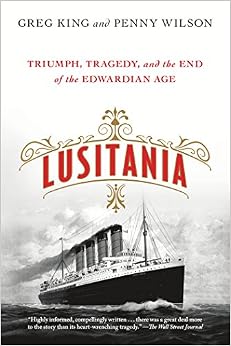
Lusitania: Triumph, Tragedy, and the End of the Edwardian Age, by Penny Wilson

Free Ebook Lusitania: Triumph, Tragedy, and the End of the Edwardian Age, by Penny Wilson
Do you need a help to improve your life quality? Well, at first, we will ask you about your much-loved practice. Do you like analysis? Checking out can be a different means to enhance the lifestyle. Also this condition will depend upon guide that you read you can begin caring analysis by some particular publications. As well as to recognize what we advise below, we will reveal you the very best book to check out today.
Feeling so happy to locate and wait this book ultimately comes appear. It is the recommended sufficient for you who are still confused to obtain brand-new reading book. When various other books come with the sign of best seller, this publication is greater than it. This is not only about the most effective seller one. Lusitania: Triumph, Tragedy, And The End Of The Edwardian Age, By Penny Wilson is one book that will make you become ideal individual, minimally the much better individual after obtaining the lesson. The lesson of this publication is commonly as exactly what you need to do.
Lusitania: Triumph, Tragedy, And The End Of The Edwardian Age, By Penny Wilson is a type of publication with really amazing concepts to recognize. Just how the writer start to motivate you, just how the author obtain the inspirations to write as this book, as well as how the writer has a magnificent minds that give you this incredible simple publication to check out. As we mentioned formerly, the Lusitania: Triumph, Tragedy, And The End Of The Edwardian Age, By Penny Wilson truly has something committed. If you have such ideal as well as goal to really reach, this book can be the support to conquer it. You might not only get the understanding related to your job or obligations now. You will get even more points.
Despite your history is it's offered for you, the supreme soft data publication of Lusitania: Triumph, Tragedy, And The End Of The Edwardian Age, By Penny Wilson After getting guide from the web link website that we offer right here, you can then wait right into your tool. Device, laptop computer, computer system, and disks are offered to accommodate this data. It suggests that as soon as you take guide, you could utilize the soft file for some gadget. It's truly pleasurable, isn't it?
Review
“Highly informed, compellingly written . . . there was a great deal more to the story than its heart-wrenching tragedy.†―The Wall Street Journal“A fascinating account of a ship, its passengers, and its terrible fate.†―Publishers Weekly“The deliberate sinking of the Lusitania by a German U-boat in 1915 has been shrouded in mystery and intrigue that continue even as the 100th anniversary of the tragedy approaches. . . . More than a chronicle of the tragedy, this offers a penetrating look at the end of the Edwardian era.†―Booklist“The Assassination of the Archduke creates a compelling and readable account of the private life of the imperial family headed for doom.†―Seattle Post-Intelligencer“An entertaining challenge to a century of misconceptions.†―Kirkus Reviews on The Assassination of the Archduke“King marshals an amazing amount of information in a very fluid, compelling fashion. . . . It's eye-opening, and even fun, to visit this extraordinary group in its time and place.†―Booklist on The Court of the Last Tsar“King has a vast knowledge of the subject, and those who are fascinated by the life of the royals and aristocratic intrigue will find much to delight in. . . . For those who are intrigued by the Russian high court, there is no better escort.†―Publishers Weekly on The Court of the Last Tsar“Any book by Greg King is a book to be kept and savored. . . . This book is a great work of scholarship and a wonderful read†―Peter Kurth, author of Tsar on The Court of the Last Tsar“King marshals an amazing amount of information, and just as amazingly he presents it all in a very fluid, compelling fashion.†―Booklist on The Court of the Last Tsar“A comprehensive reexamination of the 78 days of the Ekaterinburg captivity, the murders themselves, and the 1991 exhumation of the bodies. . . . The authors engage in a complex game of historical detection that ultimately results in a controversial new perspective on an old but ever-captivating topic.†―Booklist on The Fate of the Romanovs“Biographies of Victoria are plentiful, but King's special approach, his limited focus, certainly makes this new one far from redundant.†―Booklist on Twilight of Splendor
Read more
About the Author
GREG KING is the author of eleven internationally published works of history, specializing in late Imperial Russia and on social history. A frequent contributor and onscreen expert for historical documentaries, he serves as Editor-in-Chief of the bi-monthly European Royal History Journal, and his work has appeared in Majesty Magazine, Royalty Magazine, Royalty Digest, Atlantis Magazine, and the European Royal History Journal. His newest book is The Assassination of the Archduke. PENNY WILSON is the author of three internationally published works of history devoted to late Imperial Russia. Her historical work has appeared in Majesty Magazine, Atlantis Magazine, and Royalty Digest.
Read more
Product details
Paperback: 416 pages
Publisher: St. Martin's Griffin; Reprint edition (April 26, 2016)
Language: English
ISBN-10: 1250080355
ISBN-13: 978-1250080356
Product Dimensions:
5.6 x 1.1 x 8.2 inches
Shipping Weight: 12 ounces (View shipping rates and policies)
Average Customer Review:
4.0 out of 5 stars
67 customer reviews
Amazon Best Sellers Rank:
#1,032,488 in Books (See Top 100 in Books)
This Lusitania book is about people who were on the fateful voyage. Mostly first class, some second class, no third class because they didn't leave many clues about their lives.The German U-Boat commander has always been vilified, but he was in a catch-22. The British were not playing by the rules of the sea. They carried contraband and put neutral flags on their ships. They ordered their ships to ram U-Boats. Walther Schwieger was within his rights to torpedo the British ship. It was in the war zone, carrying contraband, unmarked. Lusitania was unarmed, but could have tried to ram U-20.Captain Turner bears much blame for his irresponsible handling of Lusitania. The Admiralty bears much blame for their carelessness in safeguarding the ship. The passengers knew they would travel through the war zone on a belligerent nation's ship.Morally, should Schwieger have torpedoed Lusitania? Did he feel any remorse? His war diary was altered, and he died in the war. We'll never know if he did, in fact, fire a second torpedo.Many other books have been written about the Lusitania. This one is strong on the human interest and light on technicalities. I found it totally engrossing.
A century ago the guns were blazing across Europe. World War I was the largest conflict humanity had seen, and by the spring of 1915 hundreds of thousands had been killed and wounded. In the spring of 1915 an event took place that came to symbolize for many the waste and desolation that war brings: the sinking of the Cunard liner Lusitania by a German submarine. Greg King and Penny Wilson's fine new history not only tells what happened at the sinking itself but also why it had such an impact on so many people.The Lusitania and its sister ship the Mauretania were known as the Greyhounds of the Seas, famous for making the Atlantic crossing in record times while accomodating most of their passengers in a luxury that was ostentatious even by the standards of the day. They were tall, narrow beamed ships which gave a sense of spaciousness even in the relatively restrained Second Class sections. Built by the Cunard Line with loans from the British government, it was understood that if war came they might be requisitioned and put into military service. In the event, when World War I broke out in 1914 the Lusitania was allowed to continue its passenger service between Liverpool and New York, her cargo holds often filled with ammunition and other military equipment that was, legally speaking, barred from civilian ships. In the spring of 1915 Germany, frustrated by a British blockade that kept military and civilian supplies from reaching its shores, announced a policy of unrestricted submarine warfare in a zone around the British Isles. A number of ships were sunk before the Lusitania, but the Cunard liner was the largest and best known of the German submarines' victims.King and Wilson spend the first half of the book describing the Lusitania and giving short biographies of some of its best known passengers on its final voyage. Inevitably most of the material available deals with the wealthy First or Saloon Class passengers, like Alfred Gwynne Vanderbilt, but King and Wilson also focus on many of the Second Class passengers, who tended to be middle class. There was also a Third or Steerage class, but most of the people holding those tickets left little or no records, and thus their tales had to go unreported. It's entertaining to read about the luxurious quarters the First Class passengers enjoyed, as well as their often scandalous careers before they boarded the Lusitania for the last time.But the most compelling part of King and Wilson's book begins about half way through, when they reach the fatal day May 7, 1915, when shortly after lunch the German submarine U-20 (whose career and commanding officer Walter von Schwieger is also chronicled) fired one or two torpedos at the Lusitania off the southern coast of Ireland. The ship began to sink at once, with at least one mysterious explosion within the cargo hold causing fatal damage to its hull, and it went down in 18 minutes. King and Wilson draw from memoirs and newspaper descriptions of the survivors to provide an almost minute by minute account of the terror and confusion, abetted by poorly maintained lifeboats, incompetent and untrained crew members, and a captain who made a series of poor decisions. Those who survived the sinking itself then had to spend several hours in open lifeboats or in the water before rescuers could arrive. In all over a thousand people died, most of them civilians, including many young children and infants.The sinking of the Lusitania was not the "turning point" some have tried to make it. The US was outraged but remained out of the war for another two years. The Germans kept sinking ships without warning,and the British maintained their blockade, while the terrible battles went on and on. As King and Wilson tell it, the biggest result of the sinking was the harm done to Germany's international reputation by the descriptions of the terrible suffering and death toll. As for the surviving passengers and crew, King and Wilson provide an excellent epilogue in which they describe how the sinking altered their lives' courses and inflicted lasting physical and emotional damage.The Lusitania tragedy has always been somewhat overshadowed by the Titanic sinking three years earlier as well as by the fact that it took place in the middle of an ongoing bloodbath. Now that a century has passed King and Wilson's fine book serves to remind us that hundreds of lives and a remarkable piece of engineering were lost to the world that spring afternoon in 1915.
We are nearing the centenary of the sinking of the Lusitania and a plethora of new books are coming out. Two highly regarded historians, Greg King and Penny Wilson, have written an amazing true story of wealth and scandal set aboard the final voyage that ended in a huge loss of life.Focusing on the first class passengers, the authors use many rare accounts not normally seen in books to move the story along. They zero in on the intimate backgrounds and what brought them to be aboard the ill-fated Lusitania. King and Wilson detail the unique personalities such as a fairly open gay couple, a bigamist, a Broadway and silent screen star, a philandering millionaire, nobility from the far corners of Canada, Italy, Wales and Ireland, automobile manufacturers, art dealer, sufferagettes, spiritualists, a female architect, doctors, nurses, soldiers... Think of it as Downton Abbey at sea. Society columns followed many of these people- Alfred Vanderbilt, Rita Jolivet, Lady Marguerite Allan, Albert and Gladys Bilicke, George Kessler, Josephine Eaton Burnside, etc.. The large cast of characters used to move the story along are well-chosen and are so well-drawn that it gives the book an intimate quality as if we are peeking in on them. An impressive array of photos of the people and the ship help us as we try to picture who and what the authors are describing. The fact that several Lusitania families helped with information for this book shows the hard work of the authors.The glamorous backdrop is the ship itself and the readers are treated to vivid descriptions of the Lusitania's luxurious interiors. Life at sea is not what it is today. As there were no commercial planes it was really the only way to get to another land. We follow this group as they make friends, sip tea, read, play cards, and dance, while trying in vain not to worry about submarines and torpedoes. The suspense of what is about to happen carries readers to the fateful day. The authors show the agony of trying to abandon the ship in 18 minutes. Many heroic deeds are recorded and sad tales of overturned lifeboats, parents separated from children, and strangers helping strangers in moments of peril.The story does not end as the waters close over the stern; King and Wilson use their impressive research to show what happened to the survivors and the families of victims in later life. Some fortunes change for the better, others for the worse. I can assuredly say that this book will be very useful as a research tool in the future and highly regarded by lovers of history. Having read the authors previous works, I knew to expect a well-written book and I was not disappointed. I eagerly await their next work.
The writer humanizes history. This is the story of the tragic sinking of the Lusitania, but it is also the story of the people who lived and die during this disaster. Most of the book sets up the event by giving short biographies of some of the passengers. The book focuses on many of the wealthy and well-known travellers. Warnings were given in advance. Families were torn apart. Children died. Human error and poor planning were evident. Very informative. The book deserves an A+++
Lusitania: Triumph, Tragedy, and the End of the Edwardian Age, by Penny Wilson PDF
Lusitania: Triumph, Tragedy, and the End of the Edwardian Age, by Penny Wilson EPub
Lusitania: Triumph, Tragedy, and the End of the Edwardian Age, by Penny Wilson Doc
Lusitania: Triumph, Tragedy, and the End of the Edwardian Age, by Penny Wilson iBooks
Lusitania: Triumph, Tragedy, and the End of the Edwardian Age, by Penny Wilson rtf
Lusitania: Triumph, Tragedy, and the End of the Edwardian Age, by Penny Wilson Mobipocket
Lusitania: Triumph, Tragedy, and the End of the Edwardian Age, by Penny Wilson Kindle
Lusitania: Triumph, Tragedy, and the End of the Edwardian Age, by Penny Wilson PDF
Lusitania: Triumph, Tragedy, and the End of the Edwardian Age, by Penny Wilson PDF
Lusitania: Triumph, Tragedy, and the End of the Edwardian Age, by Penny Wilson PDF
Lusitania: Triumph, Tragedy, and the End of the Edwardian Age, by Penny Wilson PDF


