PDF Ebook The Myth of the Paperless Office (The MIT Press), by Abigail J. Sellen
Invest your few minute to review a book also just couple of web pages. Reading book is not obligation and also pressure for everyone. When you don't want to review, you can obtain punishment from the author. Read a publication comes to be a selection of your different attributes. Many individuals with reading habit will certainly constantly be pleasurable to read, or on the other hand. For some reasons, this The Myth Of The Paperless Office (The MIT Press), By Abigail J. Sellen tends to be the depictive book in this web site.
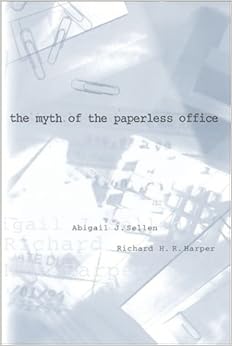
The Myth of the Paperless Office (The MIT Press), by Abigail J. Sellen

PDF Ebook The Myth of the Paperless Office (The MIT Press), by Abigail J. Sellen
Not surprising that you activities are, reading will certainly be always needed. It is not just to satisfy the obligations that you need to complete in deadline time. Checking out will certainly encourage your mind and thoughts. Certainly, reading will considerably establish your experiences concerning everything. Checking out The Myth Of The Paperless Office (The MIT Press), By Abigail J. Sellen is likewise a means as one of the cumulative books that provides many benefits. The advantages are not only for you, but for the other individuals with those purposeful advantages.
Numerous duties in this recent era need guide not only from the most recent publication, yet additionally from the old book collections. Why not? We serve you all collections from the oldest to the most recent books on the planet libraries. So, it is extremely completed. When you really feel that the book that you have is really book that you wish to read currently, it's so pleasured. But, we truly suggest you to review The Myth Of The Paperless Office (The MIT Press), By Abigail J. Sellen for your personal necessity.
Whether people have reviewing practice allots to improve the degree of the life quality, why do not you? You can additionally take some ways as just what they likewise do. Checking out The Myth Of The Paperless Office (The MIT Press), By Abigail J. Sellen will certainly give its advantages for all people. Certainly, those are individuals that truly reviewed the book as well as understand it well regarding just what guide actually suggests.
By clicking the link that our company offer, you can take guide The Myth Of The Paperless Office (The MIT Press), By Abigail J. Sellen completely. Attach to internet, download, and also conserve to your tool. Just what else to ask? Checking out can be so simple when you have the soft data of this The Myth Of The Paperless Office (The MIT Press), By Abigail J. Sellen in your device. You could also copy the file The Myth Of The Paperless Office (The MIT Press), By Abigail J. Sellen to your office computer system or in your home or perhaps in your laptop. Simply share this excellent information to others. Suggest them to see this web page and get their searched for books The Myth Of The Paperless Office (The MIT Press), By Abigail J. Sellen.
Review
If you wish to read anything at all on office management, read this book.―Guardian UKThe authors approach their subject with academic rigour, observing real organisations to find out how people like to work.―Financial TimesThe case for paper is made most eloquently in The Myth of the Paperless Office...―Malcolm Gladwell , The New Yorker
Read more
About the Author
Abigail J. Sellen is a cognitive psychologist at Hewlett-Packard Laboratories in Bristol, UK.
Read more
Product details
Series: The MIT Press
Paperback: 245 pages
Publisher: The MIT Press; Reprint edition (February 28, 2003)
Language: English
ISBN-10: 026269283X
ISBN-13: 978-0262692830
Product Dimensions:
6 x 0.6 x 9 inches
Shipping Weight: 11.2 ounces (View shipping rates and policies)
Average Customer Review:
4.4 out of 5 stars
7 customer reviews
Amazon Best Sellers Rank:
#1,001,463 in Books (See Top 100 in Books)
I bought this book from Amazon in 2005, and would recommend it to anyone with a professional or personal interest in the ways people use paper and other types of information display surfaces. It continues to provide a valuable perspective on the uses of paper in the workplace and personal life. I especially appreciate the authors' approach to studying the way office workers (in their case studies) were interacting with paper documents, in ways that were not readily supported by available computers, screens and software.As another excellent reviewer said, in 2010: "What a difference 8 years makes. ... Selen and Harper's argument does remain relevant and thought-provoking in one important respect. They explain the unique functionalities of paper to argue why paper is better for certain tasks. In the last 8 years, some technologies have started to compete with the functionalities of paper. But [paper] remains more useful than screens for some tasks. Selen and Harper's arguments at least give us the analytical tools to think about whether certain tasks are better suited to paper or computers today."Today, more than a dozen years since the book was published, many office workers have had computers since childhood.• Some have very large screens, and some use two or three screens at a time.• Some office workers (and many travelers) get by with a tablet or smartphone, for many tasks – including reading books as well as email.• People are indeed using computers more, and printing paper less.• So we could call it the “paper-less†office …However, paper still provides useful functionality, e.g., for certain research or editing tasks: when you want to flip back and forth quickly between two pages in different parts of a long document; or when multiple documents need to be viewed in parallel on a larger surface; or when one needs to consult several source documents and notes, while writing or entering data into a new document.• We can't all perform those tasks efficiently on a smartphone!• We might need more than two monitors, for some tasks.• And some of us still prefer the feel of a crisp paper document or handwritten letter, with a "wet ink" signature ...Today, the final "office work" product is almost always a digital document – unless it needs to be filed in court, or delivered to someone who doesn’t have email.• After the work is finished, the convenience copies and work papers can usually be shredded.• Increasingly, paper documents are scanned on receipt -- and saved as electronic documents for improved accessibility, sharing, collaboration, business process workflow, or business continuity.• Overall, the need for keeping paper records -- and sending them to offsite storage for long-term retention -- is decreasing.• And the need to retrieve the paper from storage has declined dramatically in recent years -- except when the electronic copies are lost, damaged or disputed.It is worth noting that human-readable paper records can prove more durable than electronic documents, which may become inaccessible after a few years for a number of technological and behavioral reasons.• To remain available and readable, electronic documents must be periodically migrated to new media (e.g., every 5 to 10 years)• The electronic document format also matters: saved documents may become unreadable over time, unless stable format standards are used (such as PDF/A)• Storage of paper documents may be necessary or advisable, when a person or organization needs to retain (and retrieve) important records over a time horizon measured in decades.Paper is not dead. It's just resting!• Unlike that Monty Python parrot ...• And we're still not sure about Schrodinger's cat ...If you were able to read all of this review without getting bored and moving on, you should definitely read the book!• As a bonus, I guarantee that you will learn one new word!
This bold and insightful analysis by two Microsoft employees into the psychological and practical reasons why certain business processes continue to rely on paper remains relevant even a decade after its publication. The book is especially helpful for records and information governance consultants more intent on providing their clients with a true understanding of the nature of their processes than selling them software solutions driven by buzz phrases including "The Paperless Office." Companies should certainly move toward imaging and digitization when feasible but the best solutions always require a sophisticated approach to rebuilding processes that recognize both opportunities, limitations and human nature.
It's lightweight and an easy read. The pricing is reasonable and content is valuable especially for information science.
What a difference 8 years makes.In 2002 it looked as though the authors were correct: the paperless office had been a myth. Technology had increased paper usage rather than decreased it. Many office workers still preferred to read and work on paper rather than screens.But about the time this book was published, the "myth" started to become true. Per-capita paper usage in offices started to decline. In my experience, most office workers have switched from paper-reading to screen-reading in the last six years. And they have switched to screens for many of the tasks that the authors argued are better suited to paper reading. The difference is new technology. For instance, the authors argue that knowledge workers prefer to review, work, and collaborate on paper documents. As a lawyer, I found that argument to be true in 2002 when text-based programs did not include useful tools for collaboration. But developments since 2002 in programs such as MS Word and Adobe Acrobat have made it much easier to do tasks such as collaborative editing on a screen instead of paper.Selen and Harper's argument does remain relevant and thought-provoking in one important respect. They explain the unique functionalities of paper to argue why paper is better for certain tasks. In the last 8 years, some technologies have been started to compete with the functionalities of paper. But some tasks remains more useful than screens for some tasks. Selen and Harper's arguments at least give us the analytical tools to think about whether certain tasks are better suited to paper or computers today.This book was ground breaking in 2002. As a lover of paper, books, and libraries, I wish Selen and Harper had been right. I would be interested to see an updated edition that addresses the usage of paper today. But as technology has advanced, the argument of the current edition has become outdated.
I read this in an archival history course. It would probably be most interesting to you if you: a) really love paper/ are a records manager or b) are interested in late twentieth-century corporate office trends.The greatest thing about it, to me, was that it was written clearly and concisely. Their major points are clearly presented in the introduction. What follows in the bulk of the book elaborates on these.
I received the "The Myth of the Paperless Office" book within a few days of ordering it. It was in perfect condition just as it was stated on the promo.
The Myth of the Paperless Office (The MIT Press), by Abigail J. Sellen PDF
The Myth of the Paperless Office (The MIT Press), by Abigail J. Sellen EPub
The Myth of the Paperless Office (The MIT Press), by Abigail J. Sellen Doc
The Myth of the Paperless Office (The MIT Press), by Abigail J. Sellen iBooks
The Myth of the Paperless Office (The MIT Press), by Abigail J. Sellen rtf
The Myth of the Paperless Office (The MIT Press), by Abigail J. Sellen Mobipocket
The Myth of the Paperless Office (The MIT Press), by Abigail J. Sellen Kindle