Download The War That Ended Peace: The Road to 1914, by Margaret MacMillan
Seeing an internet site that is extremely completed as in this area is rare. So, it's your good luck to find us. And also related to the The War That Ended Peace: The Road To 1914, By Margaret MacMillan, we offer you this book in soft file. So, you will certainly not should really feel tough to bring the printed publication when preparing to read it each time. If you really feel bemused about ways to get it, you can save the data in your gadget as well as other tool. So, when you open the gizmo, you can be reminded regarding the book inside.
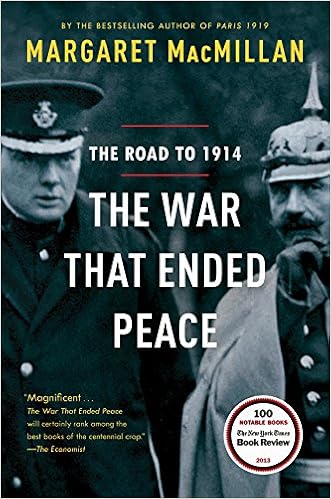
The War That Ended Peace: The Road to 1914, by Margaret MacMillan

Download The War That Ended Peace: The Road to 1914, by Margaret MacMillan
The War That Ended Peace: The Road To 1914, By Margaret MacMillan. It is the time to enhance as well as refresh your skill, expertise and also encounter consisted of some home entertainment for you after long period of time with monotone points. Operating in the workplace, visiting examine, picking up from test and more activities might be completed as well as you need to start brand-new things. If you really feel so tired, why don't you try new thing? A very easy thing? Reading The War That Ended Peace: The Road To 1914, By Margaret MacMillan is just what our company offer to you will certainly know. And also the book with the title The War That Ended Peace: The Road To 1914, By Margaret MacMillan is the referral now.
If The War That Ended Peace: The Road To 1914, By Margaret MacMillan is among the options to check out the book, you could follow exactly what we will certainly tell you now. Discovering the book could need even more times when you are browsing from store to shop. We have brand-new means to lead you get this publication rapidly. By visiting this web page, it comes to be the very first steps to obtain guide finely. This web page is type of online collection that serves so various book collections.
Furthermore, we will certainly share you the book The War That Ended Peace: The Road To 1914, By Margaret MacMillan in soft documents kinds. It will not disrupt you to make heavy of you bag. You need only computer tool or gizmo. The web link that we provide in this site is available to click and afterwards download this The War That Ended Peace: The Road To 1914, By Margaret MacMillan You recognize, having soft documents of a book The War That Ended Peace: The Road To 1914, By Margaret MacMillan to be in your device can make ease the users. So by doing this, be an excellent viewers now!
When you require likewise the various other book category or title, discover the book in this site. One to remember, we do not only offer The War That Ended Peace: The Road To 1914, By Margaret MacMillan for you, we likewise have numerous lots of the books from numerous libraries the entire world. Imagine, just how can you obtain guide from various other country quickly? Simply be here. Just from this website you could discover this problem. So, simply join with us currently.
Review
“One of the strengths of The War That Ended Peace is MacMillan’s ability to evoke the world at the beginning of the twentieth century. . . . MacMillan’s portraits of the men who took Europe to war are superb. . . . The logic of MacMillan’s argument is such that even now, as she leads us day by day, hour by hour through the aftermath of the assassination of Archduke Franz Ferdinand in Sarajevo on June 28, 1914, we expect some statesman or other to jump on the lighted fuse. . . . ‘There are always choices,’ MacMillan keeps reminding us.”—The New York Times Book Review (Editor’s Choice) “Magnificent . . . The War That Ended Peace will certainly rank among the best books of the centennial crop. . . . [MacMillan] deftly navigates the roiling currents and counter-currents of the pre-war decades. . . . The Great War had a kaleidoscope of causes. Ms. MacMillan tackles them all, with [a] blend of detail and sweeping observation.”—The Economist “The debate over the war’s origins has raged for years. Ms. MacMillan’s explanation goes straight to the heart of political fallibility. Almost every assumption made by the leaders of Europe turned out to be wrong. Elegantly written, with wonderful character sketches of the key players, this is a book to be treasured.”—The Wall Street Journal“Masterly . . . marvelous . . . Historians have long argued about why the war started and whether it could have been avoided. . . . Margaret MacMillan’s new book The War That Ended Peace: The Road to 1914 will be a welcome addition to these debates. . . . She takes a long look and examines the many forces that had been moving Europe in the direction of a war for a quarter century. . . . MacMillan is a master of narrative detail and the telling anecdote and this makes for a lively read. She does not break new ground in this book as much as present an exceptionally complex story in a way that will appeal to the general reader. Those looking to understand why World War I happened will have a hard time finding a better place to start.”—The Christian Science Monitor “Highly readable.”—The Nation “Margaret MacMillan’s The War That Ended Peace [stands] out because [it reflects] the immensely complex web of politics, power, and relationships that made war possible, if not inevitable.”—The Daily Beast“A magisterial 600-page panorama . . . a lively and sophisticated overview of the international crises that shook prewar Europe . . . MacMillan is a wry and humane chronicler of this troubled world. . . . The historian’s task, she suggests, is not to judge but to understand. . . . As MacMillan observes in a closing sentence that is well worth taking to heart, ‘there are always choices.’”—Christopher Clark, London Review of Books“[A] richly textured narrative about World War I . . . addressing the war’s build-up . . . MacMillan tells this familiar story with panache. A major contribution, however, is her presentation of its subtext, as Europe’s claims to be the world’s most advanced civilization ‘were being challenged from without and undermined from within.’ . . . MacMillan eloquently shows that ‘turning out the lights’ was not inevitable, but a consequence of years of decisions and reactions: a slow-motion train wreck few wanted but none could avoid.”—Publishers Weekly (starred review)“A first-rate study, necessary for all World War I collections. Highly recommended.”—Library Journal (starred review)“Everything can be lent a veneer of inevitability, but history rarely works in such a linear manner. But MacMillan, famous for her scholarship on the peace concluding WWI, avoids this trap. She shows, again and again, that events could have run in any number of different directions.”—Booklist “Thorough . . . lively . . . Exhaustive in its coverage of diplomatic maneuvering and the internal political considerations of the various nations, the book includes comprehensive discussions of such motivating issues as Germany’s fears of being surrounded, Austria-Hungary’s fears of falling apart and Russia’s humiliation after losing a war with Japan.”—Kirkus Reviews“The War That Ended Peace tells the story of how intelligent, well-meaning leaders guided their nations into catastrophe. These epic events, brilliantly described by one of our era’s most talented historians, warn of the dangers that arise when we fail to anticipate the consequences of our actions. This is one of the finest books I have ever read on the causes of World War I.”—Madeleine Albright, former secretary of state “With sure deftness, Margaret MacMillan manages to combine excellent history with elements of the cliff-hanger. You keep hoping that, at the last moment, one of those idiot leaders of 1914 might see the light and blink before it’s too late. No one is better equipped to recount this story than Margaret MacMillan.”—Sir Alistair Horne, author of The Price of Glory “In this epic tale of human folly, Margaret MacMillan brilliantly explores the minds of the flawed, fascinating men whose misguided decisions led to a conflagration that few wanted or believed would actually happen. The War That Ended Peace is a must-read book for our time.”—Lynne Olson, author of Those Angry Days “Once again, Margaret MacMillan proves herself not just a masterly historian but a brilliant storyteller. She brings to life the personalities whose decisions, rivalries, ambitions, and fantasies led Europe to ‘lay waste to itself’ and triggered decades of global conflict. Hers is a cautionary tale of follies a century in the past that seem all too familiar today.”—Strobe Talbott, president, Brookings Institution“The War That Ended Peace is a masterly explanation of the complex forces that brought the Edwardian world crashing down. Utterly riveting, deeply moving, and impeccably researched, Margaret MacMillan’s latest opus will become the definitive account of old Europe’s final years.”—Amanda Foreman, author of A World on Fire
Read more
About the Author
Margaret MacMillan received her PhD from Oxford University and is now a professor of international history at Oxford, where she is also the warden of St. Antony’s College. She is a fellow of the Royal Society of Literature; a senior fellow of Massey College, University of Toronto; and an honorary fellow of Trinity College, University of Toronto, and of St Hilda’s College, Oxford University. She sits on the boards of the Mosaic Institute and the Reuters Institute for the Study of Journalism, and on the editorial boards of The International History Review and First World War Studies. She also sits on the advisory board of the Institute for Historical Justice and Reconciliation and is a Trustee of the Rhodes Trust. Her previous books include Dangerous Games: The Uses and Abuses of History, Nixon and Mao: The Week That Changed the World, Women of the Raj: The Mothers, Wives, and Daughters of the British Empire in India, and Paris 1919: Six Months That Changed the World, which won the Samuel Johnson Prize, the PEN Hessell-Tiltman Prize, and the Duff Cooper Prize and was a New York Times Editors’ Choice.
Read more
See all Editorial Reviews
Product details
Paperback: 784 pages
Publisher: Random House Trade Paperbacks; Reprint edition (July 29, 2014)
Language: English
ISBN-10: 0812980662
ISBN-13: 978-0812980660
Product Dimensions:
6.1 x 1.8 x 9.2 inches
Shipping Weight: 1.8 pounds (View shipping rates and policies)
Average Customer Review:
4.2 out of 5 stars
506 customer reviews
Amazon Best Sellers Rank:
#187,625 in Books (See Top 100 in Books)
Unlike other reviewers, I found the writing neither dry nor boring. Quite the contrary I find the writing fresh and interesting. I was on the fence about giving it 4 stars or 5, but opted for 5 with the caveat that, like so many celebrities today, she cannot help but give her opinions about how 21st Century decisions by politicians she quite apparently disapproves of are somehow correlated. That being said, the actual history is well presented and while I have seen quite a bit of it in other works, her synthesis is fresh and compelling. I read quite extensively and only rarely bother to write a review because we are each so different that my opinion probably is about as useful to you as yours is likely to be to me. Having said that, if you have an interest in the foundations of the modern world, you must understand World War I, and to understand how and why this event took place, I recommend this book most highly. There are those who bring up Tuchman's The Guns of August, and with good reason: it is absolutely the best book on the opening month and causation of World War I to date. This book by MacMillan is also very good, politics notwithstanding.
Margaret Macmillan explains in clear and and thoughtful prose why Europe went to war in 1914 after a century of peace and material and social progress (following the defeat of Napoleon.) The intricacies of Balkan politics and and the ambitions of innumerable ethnic groups in southeastern Europe produced an eruption of conflict and hatred that shocked and surprised the rest of Europe, already divided by alliances and and rivalries of their own. While most observers suspected that war would eventually come from French-German bitterness over the consequences of the Franco-Prussian War of 1870, few suspected that the collapse of the Ottoman Empire would lead to minor conflicts in southeastern Europe that would drag all the Great Powers into a conflagration of unimaginable proportions. To understand the origins of the Great War and its consequences to this day, read this scholarly yet beautifully written study of a war of unimaginable tragedy.
As we approach the centennial anniversary of the outbreak of World War One we should pause to reflect on the terrible loss that conflict brought. In terms of western culture, 1914 was truly a watershed year that ended one way of life and introduced another. Margaret MacMillan followed up her epic study of the Versailles Treaty with this equally impressive work. She attempts to show how the war came about primarily because too many people either wanted war or did not do enough to prevent it from happening. The result is perhaps the most thorough analysis of the pre-1914 world available to the modern reader.MacMillan begins her book with an account of the major players (France, Germany, Russia, Britain, and Austria-Hungary) to illustrate their national hopes and dreams pitted against their fears and suspicions andn introduces the reader to the primary individuals who helped shape national policy. She then looks at the psychology of war and the peace efforts and compares them to the militarism that each nation experienced. She describes how the new concept of public opinion helped drive the leaders towards certain decisions. Next she looks at the series of run ups to the Great War's outbreak, Morocco, Bosnia, the Balkan Wars, and even the assassination of the Austrian archduke and his wife. None of these events meant that war was ultimiately inevitable. So long as there were at least some key players willing to negotiate and work through differences, war could be avoided.MacMillan concludes that war came about because the forces that sought it outnumbered and outmanourvered those who did not. But she also works to debunk myths that have evolved over the years. Germany and the Kaiser were not solely responsible for war in 1914. Germany had repeated backed down in the face of international pressure during the Morocco crises of 1905 and 1911. The Kaiser, while having the personality that modern day people would call a "jerk" (or worse), had a way of standing down at the last minute. Granted, he was fascinated with all things military, he was the inheritor of the Prussian military tradition, but he did not set out to bring war upon the world as he has often been blamed for doing. She also critiques the Anglo-French entente that developed after 1904. Britain and France were not a unified front as British leaders continually looked for ways to be non-committal in backing France on international affairs. She also looks at the relationship between France and Russia, and considers the challenges facing Austria-Hungary and the upstart Serbia. All of these have had myths develop around them and MacMillan works through the hyperbole to understand the root causes of national decisions. In fact, MacMillan ultimately blames no one and everyone for the war. The Great War, and she uses this term throughout the book, was the sum total of government's unwillingness to resort to diplomacy when the world needed eiplomacy the most.MacMillan is not only a fine historian but is also an excellent writer. Thoughout the book she interjects modern analogies to compare with her subject matter to help illustrate her points. One key such analogy appears near the end of the book when she states how John F. Kennedy employed diplomacy against the advice of his advisors in part because he had recently read Barbara Tuchman's The Guns of August. Kennedy gave diplomacy a chance, the players of 1914 did not.MacMillan's writing style is crisp and lively. Truly, there is never a dull moment in this book. College history courses should utilize this book. The leaders of today should read this book. The average citizen who thinks that guns and war solve problems should read this book. There are lessons to be learned from MacMillan that need to be understood and appreciated. This book has all the makings of a Pulitzer Prize and as such cannot be discounted by anyone who is in the position of decision-making in international affairs. And on a large scale, that really means all of us, as public opinion is now counted for much by politicians and pollsters. This book should remain the standard for a long time to come, much like her work in Paris 1919 remains the standard for understanding our modern world as it resulted from the Paris peace conference.
The War That Ended Peace: The Road to 1914, by Margaret MacMillan PDF
The War That Ended Peace: The Road to 1914, by Margaret MacMillan EPub
The War That Ended Peace: The Road to 1914, by Margaret MacMillan Doc
The War That Ended Peace: The Road to 1914, by Margaret MacMillan iBooks
The War That Ended Peace: The Road to 1914, by Margaret MacMillan rtf
The War That Ended Peace: The Road to 1914, by Margaret MacMillan Mobipocket
The War That Ended Peace: The Road to 1914, by Margaret MacMillan Kindle


0 komentar:
Posting Komentar